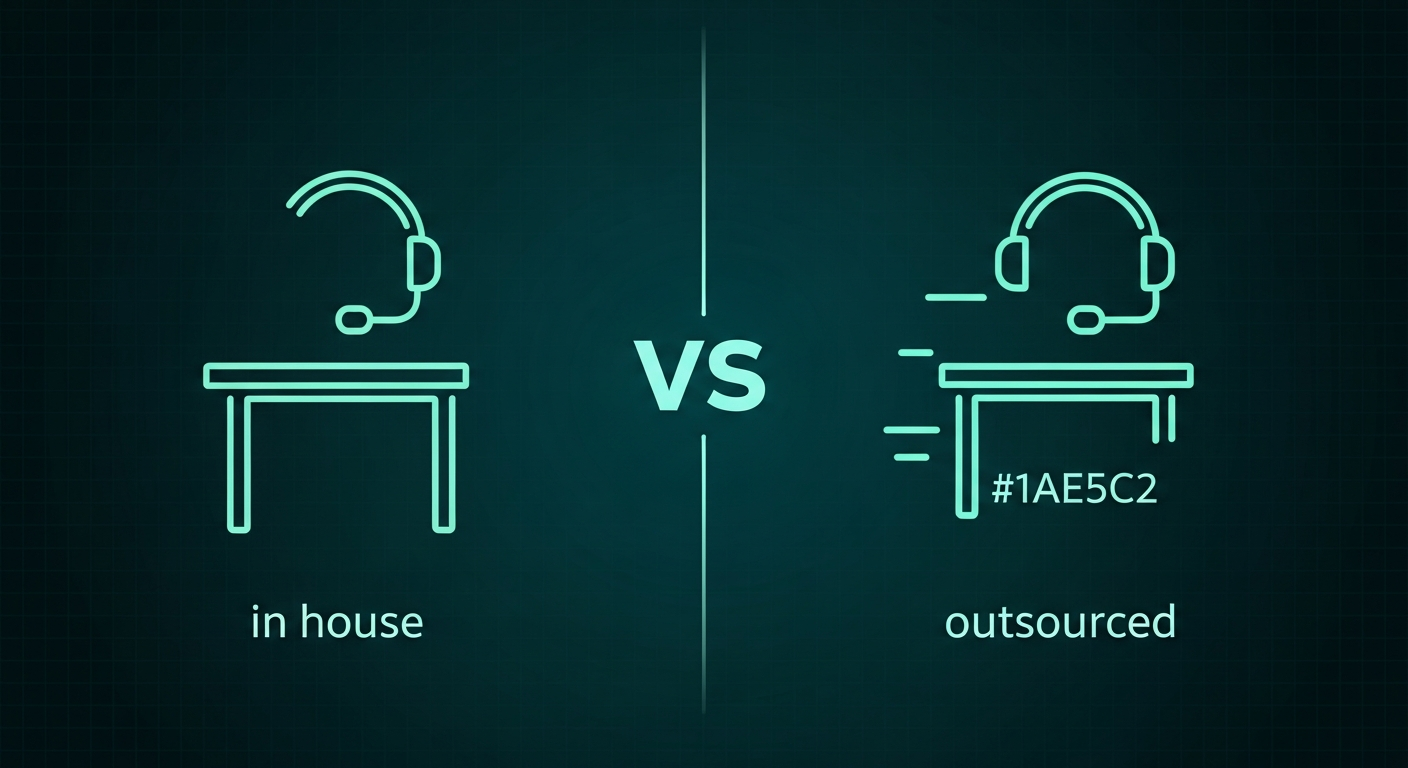
A salary is the smallest line item. Here's the full cost of an in-house medical front desk (turnover, missed calls, missed bookings) compared to an outsourced team.
Every practice owner I talk to does the same math: a front-desk receptionist costs $42K/year. An outsourced virtual front desk costs $1,500–$2,500/month, or $18K–$30K/year. So in-house is cheaper, right?
It is not. Salary is the smallest line in the actual total cost of a front desk, and it is the only one most practices ever count. Here's the full picture for 2026.
What it really costs to staff an in-house front desk
Take a single full-time medical receptionist in a US metro market. Realistic 2026 numbers, all-in:
- •Base salary: $42,000–$52,000
- •Payroll taxes and employer-paid benefits: ~22% loaded = $9,000–$11,000
- •Health insurance contribution: $6,000–$10,000
- •PTO, sick days, holidays (about 25 days/year): ~$5,000 in coverage gaps
- •Training and onboarding (amortized over an average 18-month tenure): $3,500/year equivalent
- •Recruiter or job-board spend (amortized): $1,200/year equivalent
Loaded cost per full-time front-desk seat: roughly $66,700–$82,700 per year. And that assumes the seat is filled. Average front-desk turnover in healthcare is now 32% annually, with the vacancy gap averaging 47 days. That gap is when you lose money. Calls go unanswered, bookings disappear, and your clinical team spends time covering the desk instead of seeing patients.
The hidden costs almost nobody counts
Missed calls
An average independent practice receives 80–120 inbound calls per provider per day. Industry data puts the answered-call rate during business hours at 65–78% for in-house desks (lower during lunch and after 3pm). Of the missed calls, roughly 32% are new-patient inquiries, and 71% of those callers will book at a different practice within 24 hours.
Put a number on it: a primary care practice that misses 15 new-patient calls a month is losing roughly 11 new patients per month. At an average lifetime value of $1,800 per new patient, that's about $20,000/month in lost revenue. Per provider.
Front-desk turnover
Each front-desk hire costs roughly $4,000–$7,000 to recruit, onboard, and train to productivity. At 32% annual turnover, a practice with three front-desk seats turns over about once a year. That's $4–7K of pure replacement cost per year before any productivity loss.
And the productivity loss is real: a new front-desk hire is at full productivity in about 90 days. During the ramp, denial rates tick up (eligibility errors), no-show rates tick up (reminder gaps), and patient satisfaction scores dip (mistakes, slower service).
Eligibility errors that turn into denials
When the front desk is slammed, eligibility checks get skipped. We see this in audit after audit: practices with overstretched front desks run 3–5 percentage points higher on denial rate, almost entirely from preventable eligibility issues. For a practice billing $1.2M/year, that's $36,000–$60,000 in additional denials per year. Most of those are recoverable with proper follow-up, but only if someone is doing the follow-up.
What outsourcing actually buys you
A managed virtual front desk like Carevonix doesn't replace your in-house team for the work that has to happen in-person. It replaces the work that doesn't.
- •Live answering of every call in under two minutes, including during lunch and the 3pm slump.
- •Scheduling and rescheduling directly inside your EHR using your templates and your rules.
- •Insurance verification before the visit, every time.
- •New-patient intake handled to completion: demographics, insurance, chief complaint.
- •Inbox triage and pre-visit reminders.
- •Optional after-hours and weekend coverage.
Pricing in 2026 for a fully managed virtual front desk runs $1,500–$3,500/month for a single-provider practice, scaling with volume. That's $18,000–$42,000 per year, versus $66,000–$82,000 for one in-house seat that you may or may not be able to keep filled.
The side-by-side, all-in
Solo provider, ~100 calls/day
- •In-house (1 receptionist, 78% answer rate, typical turnover): ~$70,000 hard cost + ~$15,000 in lost new-patient revenue from missed calls = ~$85,000/year all-in.
- •Outsourced virtual front desk: $1,800/month + zero missed-call gap = ~$21,600/year.
Three-provider group, ~250 calls/day
- •In-house (3 receptionists, 70% answer rate during peak): ~$210,000 hard cost + ~$45,000 lost-revenue gap = ~$255,000/year all-in.
- •Outsourced virtual front desk (full coverage): $3,800–$5,200/month = ~$45,600–$62,400/year.
When in-house still wins
Outsourcing is not the right answer for every practice. Keep it in-house if any of these are true:
- •You have a strong, tenured front-desk lead who has been with you 3+ years and rarely loses people.
- •Your patient base strongly prefers in-person interaction for everything (some concierge and small geriatric practices).
- •Your call volume is low enough (< 30/day) that one person can comfortably absorb it.
For everyone else (especially practices with 60+ calls/day, current front-desk turnover, or providers covering the phone) the all-in cost almost always favors an outsourced or hybrid model.
What to do this week
- 1.Pull your phone system report for the last 90 days. Look at calls offered vs. calls answered, and the time-of-day distribution.
- 2.Multiply your unanswered-call count by 0.32 (the new-patient share) and again by your average new-patient lifetime value. That's your annualized missed-revenue exposure.
- 3.Add up your true loaded front-desk cost, including the 47-day vacancy gap any time you've turned over in the last 18 months.
- 4.Compare those two numbers to a quote for a managed virtual front desk. If the gap is meaningful, run a 60-day pilot before making any big decisions.
The hybrid model that works best for most groups
For most multi-provider practices, the cleanest answer is not pure in-house or pure outsourced. It's a hybrid. The split that works in the field:
- •Keep in-house: one tenured lead at the front desk who handles in-person check-in, in-room patient questions, and is the friendly face the regulars know. This role gets stable and rewarding when it isn't also responsible for the phones.
- •Move outside: phones, scheduling, eligibility, intake, and inbox triage. These are queue-based tasks that benefit from a team that does only this all day and never has to context-switch to a patient walking in.
- •Keep clinical decisions in-house: anything that requires reading the chart or asking the provider. Outsourced teams escalate; they don't decide.
This split typically lets a practice run with one fewer in-house seat and significantly better answered-call performance, while keeping the patient experience anchored by a familiar face.
Questions to ask any outsourced vendor before you sign
Not all virtual front desk services are built the same. Before you commit, get straight answers to these:
- 1.Do you work inside our EHR and our scheduling templates, or do you require us to use yours? (The right answer is yours.)
- 2.Is the team that answers our calls dedicated to us, or shared across many practices? (Dedicated is much better for quality.)
- 3.Is the team US-based, healthcare-specialized, and HIPAA-trained? Ask for the actual training program.
- 4.What's the answered-call rate and average answer time you commit to? Get it in the SLA, not the brochure.
- 5.How are calls handed off when something has to escalate to the in-house team or a provider?
- 6.What does monthly reporting look like? Ask for a sample.
- 7.What happens during your team's PTO or sick days? Is there real backup coverage?
If a vendor stumbles on more than one or two of these, keep shopping. The cost of switching after a bad fit is much higher than the cost of an extra week of diligence.